Somalia
- works
- 17
- 13 books · 4 films
- period covered
- 1907–1994
- language of writing
- Somali
Somali had no official writing until 1972. Until then, one of the strongest poetic traditions in the world had been transmitted without a written line: poems of several hundred verses, composed according to strict rules of alliteration, learnt by heart and recited from camp to camp by specialists who carried them intact over hundreds of kilometres. The government decreed the Latin alphabet in 1972, launched a literacy campaign, and a written literature began.
Read moreShow less
Poetry was not an ornament in that society. It served to negotiate, to insult, to demand reparation, to declare war and to stop it. Once, a poet named Salaan Carrabey came between two clans on the point of fighting and recited a poem entitled "Stop the war"; the fight did not take place. Earlier, the leader of the resistance against the British was himself a great poet, and his adversaries acknowledged his literary worth while fighting him.
Hence a written literature that remains inhabited by the oral. Faarax Cawl published in 1974 the first novel in Somali, which stages an illiterate young man unable to read the letters of the woman he loves, a subject that says everything about the moment. Hadraawi became in the nineteen seventies the most listened-to poet in the country and spent five years in prison. Nuruddin Farah chose English and wrote from exile a body of work about dictatorship. The price was collapse: after 1991, the state disappeared, and with it the publishing houses, the schools and the film studios that had produced films in the nineteen sixties and seventies.
What awaits the reader is a literature in which the poem keeps a prestige the novel does not have, and in which speech commits. The novel that opens this page follows a dentist trying to learn why his twin brother died, under Siad Barre's dictatorship, and it was written in the first years of its author's exile.
A way to begin
Sweet and Sour Milk
Nuruddin Farah · 1979
A dentist seeks to learn why his twin brother died in a single day, under Siad Barre's dictatorship: the first part of a trilogy by Nuruddin Farah.
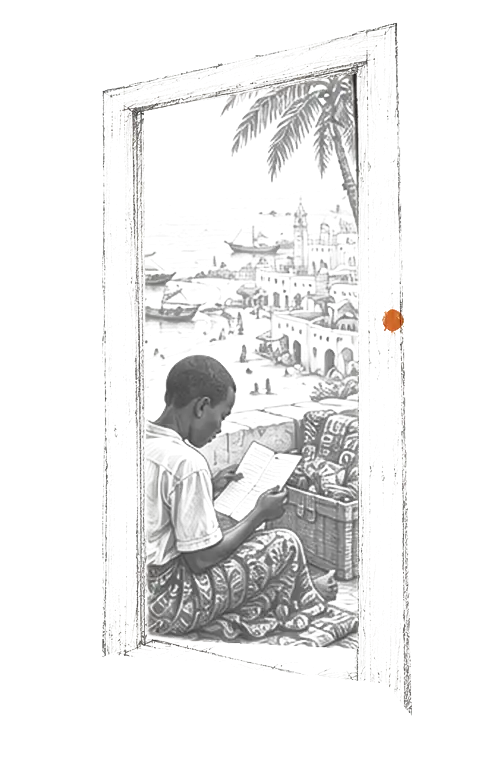
In Mogadishu, Soyaan, a government employee, dies suddenly of an illness that carries him off in a day, and the family refuses an autopsy. His twin Loyaan, a Western-trained dentist, discovers that he knew almost nothing of his brother: an article hostile to the regime is hidden in his pillowcase, a minister asks questions at the funeral, and the authorities make the dead man a hero, attributing to him last words he never spoke.
Timeline
- 1910–1940Oral poetryThe gabay of Sayyid Maxamed Cabdille Xasan, spoken against the British.
- 1961–1973First filmsManrok, Cagakombe, Mohammed Goma Ali. Somalia films before it writes.
- 1972–1982The language in writingThe Somali alphabet is adopted in 1972; Faarax Cawl publishes the first novel.
- 1979–1987Farah and exileSweet and Sour Milk opens a trilogy against Siad Barre.
Reading keys
- There is no family name: everyone bears his first name, that of his father and that of his grandfather, and recites his genealogy over twenty generations if need be.
- That genealogy places the clan and the sub-clan, decisive information in social and political life. A name is an address.
- The clan system and the customary agreement, the xeer, settle compensations and conflicts outside any state.
- Patrilineal kinship is strict, and clan belonging passes through the father whatever the place of birth.
- The civil war since 1991, the famines and the role of the clans in the collapse are subjects on which every account is situated.
- Clanism is officially denounced and socially omnipresent, and authors name it at their own risk.
- The dictatorship of Siyaad Barre, from 1969 to 1991, sent most of the known poets to prison.
- Excision, very widespread, is a subject addressed by women writers and film-makers of the diaspora.
- Sunni Islam is practised by the whole population, with old Sufi brotherhoods and visited local saints.
- Waaq, the name of the pre-Islamic sky god, survives in place names and in formulas of blessing.
- The jinn belong to Quranic cosmology, and healing rites through saar deal with possessions.
- The tombs of saints and local pilgrimages have been attacked by recent rigorist movements, which is a contemporary stake.
- Muslim mourning is brief, with burial on the same day and three days of condolences.
- The white of the men's robe and the women's cloths indicate the occasion, and henna marks weddings.
- The camel is the unit of value, of compensation and of poetry: a poem may count camels like a contract.
- Ramadan and the Eids order the calendar, and the rainy seasons, gu and dayr, organise movements and narratives.
- The poems of Maxamed Cabdille Xasan, leader of the resistance from 1899 to 1920, are learnt and recited, including by those who contest his action.
- The gabay, a long alliterative poetic form, is the genre of prestige, and the buraanbur that of women.
- The xeer, oral customary law, is a legal reference that the narratives assume is known.
- The Somali and Afar tales collected at the beginning of the twentieth century form the available documented corpus.
- The absence of writing before 1972 indicates no literary poverty: Somali poetry is held by specialists to be one of the most elaborate in the world.
- The clan is not a tribal survival but an active legal and political structure, with its rules of compensation.
- Somalia is not a country without a culture of state: it had film studios, a university and publishing houses before 1991.
- Somaliland and Puntland have distinct trajectories, and a text may designate one without speaking of the other.
Tales and mythologies 1
- PoetryGudbanMaxamed Cabdille Xasan · 1907not translated into EnglishAfter the Illig agreement, which fixed the limits of their territory, the dervishes return to their former lands in the Nugaal and prepare to resume the war.Literature
Available in English 9
The books from this country that can be read in English, in the original or in translation.
- PoetryThe News to RomeAnnagoo Taleex naalIsmaaciil Mire · 1913The verse account of a raid by the Somali Dervishes on the British colonial troops.Literature
- PoetryOh Clansmen, Stop the WarWaar tolow colka joojaSalaan Carrabey · 1920A poem recited before two related troops about to clash, in a society where the poet's word weighs on war and peace.Literature
- NarrativeThe Life and Adventures of a SomaliIbrahim Ismaa'il · 1928A Somali sailor settled in England since the end of the Great War tells his life to an anthropologist friend, in a libertarian colony in the Cotswolds.Literature
- TheatreLeopard Among the WomenShabeelnaagoodXasan Sheekh Muumin · 1968The golden age of Somali theatre begins, and the radio now pays poets and playwrights for their work.Literature
- NovelIgnorance is the Enemy of LoveAqoondarro waa u nacab jacaylFaarax M. J. Cawl · 1974In 1972, Somali received an official script, and the state launched literacy campaigns in the towns, then in the countryside.Literature
- PoetryAllayl dumayRaage Ugaas · 1976A love lament by the most admired of the classical Somali poets, handed down from memory since the nineteenth century.Literature
- PoetryPassing CloudFad GalbeedMaxamed Xaashi Dhamac “Gaarriye” · 1978A Somali lyric poem in which the setting sun flees before the beauty of a young woman.Literature
- NovelSweet and Sour MilkNuruddin Farah · 1979In 1975, Somalia lives under the military dictatorship of Siad Barre, in a climate of surveillance and repression.Literature
- NarrativeFar from MogadishuLontano da MogadiscioShirin Ramzanali Fazel · 1994In 1991, civil war begins to ravage Mogadishu, a city the author left twenty years earlier for Italy.Literature
A selection to begin with 10 / 17
- PoetryOh Clansmen, Stop the WarWaar tolow colka joojaSalaan Carrabey · 1920A poem recited before two related troops about to clash, in a society where the poet's word weighs on war and peace.Literature
- CinemaMiyi iyo MagaaloHajji Cagakombe · 1968The first feature-length fiction film made by a Somali, a few years after independence.Cinema
- TheatreLeopard Among the WomenShabeelnaagoodXasan Sheekh Muumin · 1968The golden age of Somali theatre begins, and the radio now pays poets and playwrights for their work.Literature
- PoetrySiinleyMaxamed Ibraahin Warsame "Hadraawi" · 1973not translated into EnglishSince the coup of 1969, Somalia has lived under the dictatorship of Siad Barre, and criticism can only be expressed in veiled terms.Literature
- NovelIgnorance is the Enemy of LoveAqoondarro waa u nacab jacaylFaarax M. J. Cawl · 1974In 1972, Somali received an official script, and the state launched literacy campaigns in the towns, then in the countryside.Literature
- PoetryAllayl dumayRaage Ugaas · 1976A love lament by the most admired of the classical Somali poets, handed down from memory since the nineteenth century.Literature
- PoetryPassing CloudFad GalbeedMaxamed Xaashi Dhamac “Gaarriye” · 1978A Somali lyric poem in which the setting sun flees before the beauty of a young woman.Literature
- CinemaThe Somali DervishSaid Salah Ahmed · 1985The shoot, in the mid-eighties, benefits from a subsidy from President Siad Barre, rare resources for Somali cinema.Cinema
- CinemaGeedka noloshaAbdulkadir Ahmed Said · 1988A fable on the bond between people and nature, shot on 16 mm shortly before 1990 by a filmmaker of the national film agency.Cinema
- DocumentaryFire EyesSoraya Mire · 1994A Somali documentary on excision, its consequences and what it says about the condition of women.Cinema