Switzerland
- works
- 40
- 24 books · 16 films
- period covered
- 1816–1999
- language of writing
- French and German
On 19 June 1762, the Small Council of Geneva had the executioner tear up and burn, before the door of the town hall, the two books Jean-Jacques Rousseau had just published on education and on the political contract. A warrant was issued against the author, a citizen of Geneva, who would never set foot there again. The judgements were annulled thirty years later. The treatise, printed in Amsterdam, was already circulating everywhere.
Read moreShow less
This country produced European ideas and expelled those who had them, while serving as an asylum for those whom others drove out: Büchner died in Zurich in 1837, Joyce wrote there and is buried there, Thomas Mann ended his life there, Musil died in Geneva. Switzerland has four official languages and no common literary space: a German-Swiss author is read in Germany, a French-speaking one in Paris, a Ticinese in Italy, and they largely ignore one another. Literature there is therefore regional and its central question is narrowness.
The form is the parable and the trial: Dürrenmatt brings back in 1956 a billionairess who buys a murder from her village, Max Frisch constructs novels in which an engineer refuses to believe in chance. The price is discreet, like the country. Robert Walser spent the last twenty-three years of his life in an asylum and stopped writing. The Italian seasonal workers of the nineteen sixties, housed in huts and forbidden to bring their families, were filmed in 1964 by Alexander Seiler, and the 1978 comedy about naturalisation remains the greatest success of Swiss cinema. In 1989 it was discovered that the Confederation kept files on hundreds of thousands of people, writers included.
What awaits the reader is a literature of order and of what it costs, written by people who know that their country is thought boring. The novel that opens this page, published in two volumes in 1880 and 1881, takes an orphan to an alpine pasture and then to Frankfurt, and it has fed the myth of a Swiss people living innocently in the mountain air.
A way to begin
Heidi
Luigi Comencini · 1952
An orphan between an alpine pasture in the Grisons and a bourgeois house in Frankfurt: one of the best-selling books in the world, free of rights.
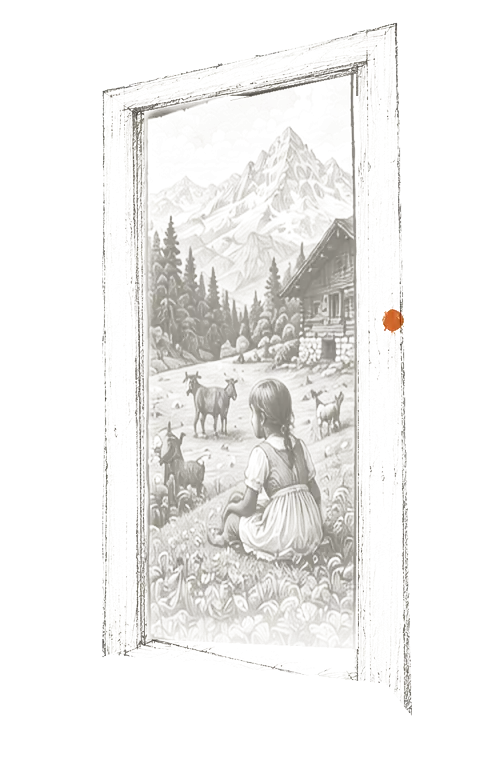
Heidi, a five-year-old orphan, is taken by her aunt to her grandfather, the Alm-Uncle, an old man who lives alone in a chalet above the village and whom everyone avoids. She grows attached to him, herds goats with Peter and learns the mountain. Three years later her aunt comes back to fetch her to keep company with Clara, a rich child who cannot walk, in Frankfurt, where the city house makes her sick for what she has left.
Timeline
- 1750–1780EnlightenmentRousseau, born in Geneva, shakes the whole of Europe.
- 1880HeidiSpyri fixes the image of the Swiss mountain once and for all.
- 1950–1990Dürrenmatt and FrischTwo German-Swiss playwrights turn Switzerland into a place of moral questioning.
Reading keys
- The place of origin, the commune where the family has been registered for generations, figures in the papers and counts for more than the actual residence: a character may be a burgher of a village he has never lived in.
- Names are distributed by language, and a German name in Geneva or a French one in Bern tells of an internal migration.
- Double first names and dialect diminutives distinguish family usage from administrative usage.
- Kinship through the commune and through the local society, choir, shooting club, gymnastics, structures village narratives.
- Switzerland's role during the Second World War, the refusals at the border, the dormant assets and the trade with Germany were established by an official commission and remain uncomfortable.
- The regime of seasonal workers, the children placed by force and the administrative internments until 1981 are subjects acknowledged late, with reparations.
- Banking secrecy, its end and taxation are subjects on which the country knows it is judged.
- Women's right to vote, obtained in 1971 at federal level and in 1990 in one canton by judicial decision, is a fact that literature does not forget.
- The dividing line between Protestant and Catholic cantons dates from the sixteenth century and still determines festivals, schools and the tone of a region.
- Geneva and Zurich were capitals of the Reformation, with a moral discipline that left traces in the language and in literature.
- Alpine narratives are peopled with glacier spirits, cursed cows and punished villages, material that Ramuz and Gotthelf treat seriously.
- The Catholicism of the original cantons, with its processions and its votive offerings, provides another imagination, more baroque, within the same country.
- 1 August, the national day, is celebrated with fires on the heights and communal speeches, without a military parade.
- The carnivals of Basel and Lucerne, with their cliques and their masks, are regulated in detail and last three days.
- The autumn descent from the mountain pastures, the winegrowers' festival and the shooting competitions are communal rites that the texts use as landmarks.
- Funerals are brief and discreet, and assisted death, legal under conditions, appears in recent literature as a social fact.
- William Tell is the founding myth, largely written by a German, and Swiss literature discusses it more than it celebrates it.
- Heidi, in 1881, is the country's most exported reference, and its tourist use irritates the authors who write against it.
- Gotthelf's stories, including the black spider of 1842, form the German-Swiss narrative stock, harsh and theological.
- Mountain narratives, avalanches, closed passes, cut-off villages, are a genre in themselves, whose language Ramuz fixed.
- There is no such thing as one Swiss literature but four, German, French, Italian and Romansh, which are read separately and rarely together.
- Spoken Swiss German is an everyday language very far from written German, and that gap is a literary subject in its own right.
- Neutrality and prosperity are recent on this scale: in the nineteenth century, Switzerland was a poor country from which people emigrated and whose soldiers were hired out.
- Rousseau, Constant, Cendrars and Yourcenar circulate between several national catalogues: belonging here is a convention.
- The catalogue stops in the mid nineteen eighties, which measures the state of translations and not current production.
Tales and mythologies 1
- NarrativeWalliser SagenJohannes Jegerlehner · 1922not translated into EnglishThe high Alpine valleys, where whatever falls from the mountain is held to be the wage of faults committed below.Literature
A selection to begin with 10 / 40
- NovelAdolpheBenjamin Constant · 1816The small courts of Germany and Poland at the beginning of the century, where a young man from a good family does not know what to do with his freedom.Literature
- NovelHeidiJohanna Spyri · 1881A mountain pasture in the Grisons and a bourgeois house in Frankfurt, at a time when people believe that mountain air heals what the city damages.Literature
- NovelJakob von GuntenRobert Walser · 1909An institute in Berlin at the beginning of the century, whose pupils leave as servants and leave as nothing else.Literature
- NovelGreat Fear on the MountainLa Grande Peur dans la montagneCharles Ferdinand Ramuz · 1926A high mountain pasture and its village, in the twenties, where what the elders say is weighed against what the animals bring in.Literature
- TheatreThe VisitDer Besuch der alten DameFriedrich Dürrenmatt · 1956A small, ruined town with no country, where people have just learned that a fortune can be bought at the price of a single man.Literature
- NovelHomo FaberHomo faberMax Frisch · 1957America, the Atlantic and Greece in the fifties, crossed by a man who holds figures to be the only serious thing.Literature
- Feature filmSiamo italianiAlexander J. Seiler · 1964Switzerland in the early sixties, where more than half a million Italians keep the economy running and are seen as a problem.Cinema
- Feature filmSan GottardoVilli Hermann · 1977Switzerland of the great Alpine construction sites, which brings in men from elsewhere to cut through the mountain and sends them back afterwards.Cinema
- Feature filmThe SwissmakersDie SchweizermacherRolf Lyssy · 1978Switzerland in the late seventies, where becoming Swiss is granted at the end of a neighbourhood inquiry.Cinema
- Feature filmLes Petites FuguesYves Yersin · 1979The farms of the Vaud region before 1980, when a farmhand spends his whole life without ever being asked his opinion.Cinema