Suriname
- works
- 16
- 15 books · 1 film
- period covered
- 1886–1987
- language of writing
- Dutch
Around 1830, near a plantation, a child named Adiri was born, of a Matawai family linked to the line of the great chiefs, in a society without writing. Ill for years, he began in 1855 to receive visions ordering him to walk towards the town. He went down to Paramaribo, was baptised under the name of Johannes King, taught himself to write, and became the first important author in Sranan. His Book of Terrors is the account of what he saw.
Read moreShow less
Suriname produces that kind of trajectory because it is made of juxtaposed worlds. In 1760 and then in 1762, the Ndyuka and the Saramaka, descendants of runaway slaves, signed treaties with the Dutch recognising their freedom and their territory. Abolition would wait until 1863. For a century, a free black society therefore existed in the forest, at the heart of a slave colony. The country today has fewer than six hundred thousand inhabitants and more than twenty languages.
Hence the question that this country puts relentlessly to its writers, and which is its real question of form: in what language to write, and for whom. Dutch is official and opens the doors of Amsterdam. Sranan is spoken by almost everybody, and it is in Sranan that Trefossa made a language of poetry. André Pakosie writes in Ndyuka. Cynthia McLeod writes in Dutch the history of slave-holding Paramaribo, after discovering in the archives that the richest woman in the town was black and the daughter of a former slave. None of those choices is neutral, and each designates an audience.
What awaits the reader is therefore a text that changes language along the way. The passage from Dutch to Sranan states who is speaking to whom and from what position. Proverbs slip into it untranslated. And the forest remains an elsewhere a few hours from the capital, where history did not follow the same course. The 1926 novel that opens this page is written by a man who left for the Netherlands, and it turns against the country that colonised his own.
A way to begin
Zuid-Zuid-West
Albert Helman · 1926
The song of nostalgia of a young Surinamese in Holland, coupled with an indictment of what colonisation did to his country.
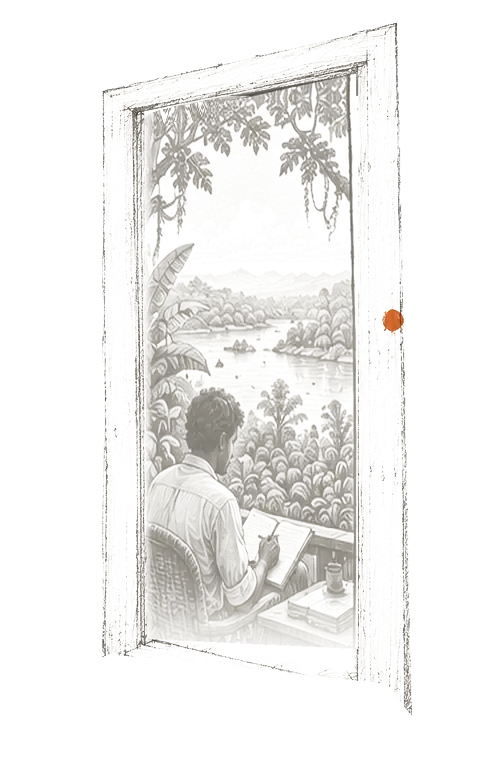
A man in his twenties, far from his country, gathers in fragments the memories of his childhood in Suriname: the beauty of the rivers and forests, the peoples who live there, solitude. The song of nostalgia doubles as an indictment: natives driven out, slaves brought from afar, communities set against one another, immigrants stripped of their rice fields, land plundered by those who govern it.
Timeline
- 1895–1926First textsJohannes King in Sranan, then Albert Helman's Zuid-Zuid-West.
- 1974–1977After independenceTrefossa makes Sranan Tongo a language of poetry.
- 1976Wan PipelPim de la Parra films a plural country, in Sranan and in Dutch.
- 1987–1999ContemporariesCynthia McLeod and her sugar novel, Doris Vrede, John Slagveer.
Reading keys
- Afro-Surinamese family names are often Dutch, assigned at the moment of abolition. A European surname therefore indicates no European ancestry.
- Hindustani, Javanese and Chinese names coexist with them, and the name alone immediately places a character in a community, which a foreign reader does not perceive.
- Maroon societies are matrilineal and organised in lineages, the lo, under the authority of a granman assisted by kapitens. The kinship that counts passes through the mother.
- Nicknames in Sranan are in constant use and may entirely replace the official name.
- The coup of 1980 and the assassinations of December 1982 remain a high-tension subject. The works that approach them do so by allusion or by displacement.
- The internal war of the nineteen eighties between the army and the Jungle Commando left a silence that weighs on every representation of the binnenland.
- Relations between communities are rarely stated head-on. Mixed marriage is the place where the conflict becomes visible, which explains why it is such a frequent narrative device.
- The greeting in Sranan, fa waka, opens almost every conversation and its reciprocal is obligatory.
- Deference towards elders is explicit, including between adults, and one does not call an elder by their first name alone.
- The pangi, a knotted piece of cloth, marks among the Maroons belonging and occasion. Its colour and its pattern are legible to those who know.
- Four ensembles coexist: Afro-Surinamese winti, Hinduism, Islam mainly Javanese, and Christianity of which the Moravian mission is historically dominant. Many characters practise two systems without seeing a contradiction in it.
- Winti was long forbidden by the colonial administration, and that clandestinity explains why it is practised in the works at a remove, at night, outside the town.
- The spirits, winti, take possession of the body during the dance. A scene of trance is not a scene of madness.
- The ancestors must be fed and consulted. A character who neglects that duty is exposed, and the narrative will make him pay for it.
- Afro-Surinamese mourning unfolds over eight days of wake, the dede oso, with songs, games and narratives until morning. It is not a lack of respect, it is the rite.
- White is present in several Afro-Surinamese rituals, notably for the officiants, while black dominates urban Christian mourning.
- On the first of July, Keti Koti, "the chains broken", commemorates the abolition of 1863 and gives rise to a codified traditional dress.
- The Hindu and Muslim festivals are public holidays on the same footing as the Christian ones, which produces a shared calendar unique in the region.
- Anansi the cunning spider runs through the whole Afro-Surinamese stock under the name of Anansi-tori. It is the same figure as in Ghana, in Sierra Leone, in Jamaica and in Curaçao.
- The odo, proverbs in Sranan, are used as arguments in a conversation and are never translated in the text.
- Boni, Baron and Joli-Coeur, leaders of the eighteenth-century Maroon resistance, are national heroes.
- Elisabeth Samson, a black and free woman, the richest in Paramaribo in the eighteenth century, has become a reference figure since the work of Cynthia McLeod.
- In Suriname, "creole" designates Afro-Surinamese people, and not people of mixed race. The sense differs from the one it has in the French Antilles.
- "Maroon" or bushinengue does not designate a marginal rural community but peoples with treaties, territories and institutions of their own.
- The Dutch spoken in Suriname is not the Dutch of the Netherlands, and a character who speaks "as in Amsterdam" is socially marked.
- The apparent multicultural harmony vaunted by official discourse is precisely what the works question. Taking it at its word means missing their subject.
Tales and mythologies 1
- NarrativeTemekoeEdgar Cairo · 1969not translated into EnglishA twenty-year-old student, having left for Amsterdam, publishes at home a first narrative written in the Creole language of the street.Literature
Available in English 4
The books from this country that can be read in English, in the original or in translation.
- EssayWe Slaves of SurinameWij slaven van SurinameAnton de Kom · 1934Expelled without trial from his native colony, an anticolonial activist completes in the Netherlands a book on the colonial past as seen by the enslaved.Literature
- NovelMy Name Is SitaSarnami, haiBea Vianen · 1969The portrait of a Hindustani adolescent girl in Suriname, torn between her family and her desire for freedom.Literature
- NovelOn a Woman's MadnessOver de gekte van een vrouwAstrid Roemer · 1982The novel that revealed Suriname's greatest novelist to the Netherlands, the story of a woman who chooses her freedom.Literature
- NovelThe Cost of SugarHoe duur was de suikerCynthia McLeod · 1987A former teacher of Dutch draws from the colonial archives a novel about the time when sugar made the country's fortune.Literature
A selection to begin with 10 / 16
- NarrativeSkrekiboekoeJohannes King · 1886not translated into EnglishConverted by visions, a Maroon preacher who came late to writing sets down on paper, in the Creole language of the country, what the forest showed him.Literature
- NovelEen beschavingswerkRichard O'Ferrall · 1923not translated into EnglishThe colony has just abandoned, in the middle of the forest, the railway that was meant to open up the interior, and a notable of Paramaribo draws a satire from it.Literature
- EssayWe Slaves of SurinameWij slaven van SurinameAnton de Kom · 1934Expelled without trial from his native colony, an anticolonial activist completes in the Netherlands a book on the colonial past as seen by the enslaved.Literature
- PoetryTrotjiHenri Frans de Ziel (Trefossa) · 1957not translated into EnglishWhile the school still forbids the country's Creole language, a schoolteacher in Paramaribo proves that it can serve learned poetry.Literature
- PoetrySarka / Bittere strijdMichaël Slory · 1961not translated into EnglishThe first book in Sranan by a militant poet of Suriname, a collection of anticolonial struggle.Literature
- NovelMy Name Is SitaSarnami, haiBea Vianen · 1969The portrait of a Hindustani adolescent girl in Suriname, torn between her family and her desire for freedom.Literature
- PoetryOm de zonMartinus Haridat Lutchman (Shrinivāsi) · 1972not translated into EnglishThe largest collection of the great Hindustani poet of Suriname, a love journey from India to the Caribbean.Literature
- CinemaWan PipelPim de la Parra · 1976A year after independence, a filmmaker born in Paramaribo shoots the first feature-length fiction film of the new state.Cinema
- NovelOn a Woman's MadnessOver de gekte van een vrouwAstrid Roemer · 1982The novel that revealed Suriname's greatest novelist to the Netherlands, the story of a woman who chooses her freedom.Literature
- NovelThe Cost of SugarHoe duur was de suikerCynthia McLeod · 1987A former teacher of Dutch draws from the colonial archives a novel about the time when sugar made the country's fortune.Literature