Syria
- works
- 44
- 27 books · 17 films
- period covered
- -1350–1997
- language of writing
- Arabic
The first alphabet in history was found in 1929 on a hill of the Syrian coast. At Ras Shamra, ancient Ugarit, archaeologists uncovered tablets bearing a cuneiform writing reduced to some thirty signs, each noting a consonant and not a syllable or a word. That invention of the fourteenth century before our era is the distant ancestor of all alphabets, from Phoenician to Greek, from Latin to Arabic. The same tablets yielded a whole mythology, with Baal, El and Anat.
Read moreShow less
Syria was long that kind of place of passage and of invention. Damascus claims to be one of the oldest continuously inhabited cities, Aleppo was a crossroads of trade between the Mediterranean and Asia, and the country has produced a continuous learned Arabic literature since the tenth century, with a blind and sceptical poet whose epistle on paradise, written around 1033, preceded Dante by three centuries. That depth feeds an acute consciousness of being a centre become a periphery, and the Syrian poets of the twentieth century never stop returning to it.
The dominant form in the twentieth century is poetry, and it served to say what prose could not. Nizar Qabbani wrote the body and desire in a simple language that scandalised, then the defeat of 1967 in terms so raw that his poems were banned. Adonis recast Arabic metrics and has lived in Paris since 1985. Saadallah Wannous invented a theatre in which the audience is taken to task, with a 1969 play about a king and an elephant that nobody dares criticise. The price is known: censorship, prison, exile, and since 2011 the complete dispersal of the literary milieu, part of which writes today from Berlin, from Beirut or from Istanbul.
What awaits the reader is a writing of allusion and of political metaphor, in which the reader must do half the work. The collection that opens this page appeared in 1944, it spoke of love, and that was enough to cause a scandal.
A way to begin
قالت لي السمراء
Nizar Qabbani · 1944
Nizar Qabbani's first collection, whose sensual love poems caused a scandal in Damascus in 1944.
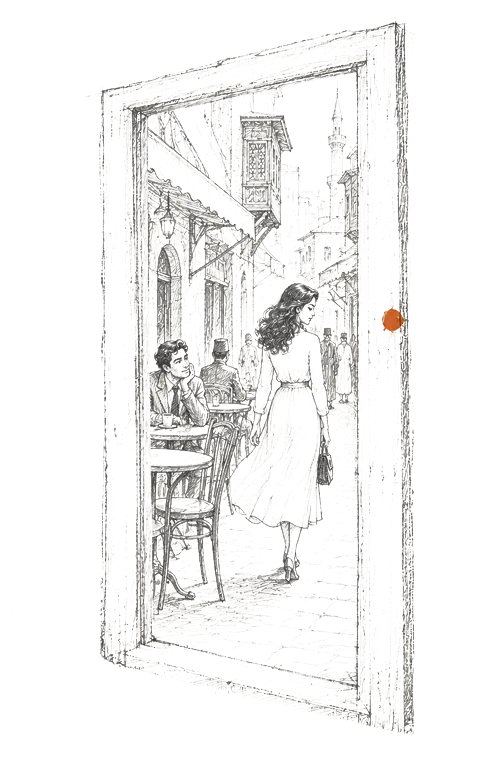
Some thirty love poems, opened by a page addressed to the reader. The poet speaks in the first person of a woman's body and his own desire: a passer-by who sets a whole street in motion, a first rendezvous, a woman glimpsed in a café, another who admits she is starved of love, letters he asks for.
Timeline
- 1893–1930Syrian NahdaMaryana Marrash, Khalil Mardam. Damascus and Aleppo write the Arab renaissance.
- 1944–1965Modern poetryQabbani, Adonis, al-Maghut. The language sheds its rhetoric.
- 1954–1975Committed novel and theatreHanna Mina, Ghada al-Samman, Wannous. Writing under one-party rule.
- 1928–1972First filmsFrom Rashid Jalal to Tawfiq Saleh's The Dupes, a cinema under supervision.
- 1980–1993Auteur cinemaMalas, Zikra, Abdelhamid, Maleh. Few films, all of them watched.
Reading keys
- The name reads as a genealogy, and the surname often indicates the town or the region of origin, an important social piece of information between Damascus, Aleppo and the countryside.
- The name may signal the confession: Christian, Alawite, Druze and Sunni first names are not to be confused, and that legibility is a social fact.
- Kurdish names, from the north-east, are distinguishable from Arabic names, and Kurdish was long forbidden in writing.
- The kunya, "father of" followed by the name of the eldest child, is the ordinary respectful form of address.
- The regime installed in 1963, the Hama massacre in 1982 and the war since 2011 are subjects on which every account is situated and sometimes dangerous.
- The confessional question, notably the place of the Alawites in the state apparatus, is not approached head-on.
- The Kurdish question and the prohibition of Kurdish produced a literature written in Arabic by Kurdish authors.
- Theatrical censorship was particularly attentive, which explains the place of historical allegory.
- Sunni Islam is in the majority, with Alawite, Druze, Ismaili and Christian minorities of several rites, some of them with liturgies still in Aramaic.
- The Alawites have an esoteric doctrine to which access is reserved, which has fed mistrust and fantasy.
- The cult of saints and the mausoleums, Christian as well as Muslim, are visited by both confessions.
- The ancient stock of Ugarit, with Baal confronting the sea and death, and the sanctuary of Hierapolis described in the second century, constitute the oldest layer.
- Muslim mourning is brief, with burial on the same day, three days of condolences and a commemoration on the fortieth.
- Black is worn for a long time by bereaved women.
- Ramadan reverses the rhythm of the days, and the evening gatherings become the time of narrative and of coffee.
- The Christian festivals, including Easter according to two different calendars, punctuate the year in the neighbourhoods concerned.
- The Baal cycle, the legend of Aqhat and the epic of Kirta, found at Ugarit, are the mythological stock of the country, but their reliable translations are recent and protected.
- The Syrian recension of the Thousand and One Nights, including the manuscript used by Galland, is the oldest and the most sober.
- Classical Arabic poetry, with al-Maarri and al-Mutanabbi who lived in Aleppo, is a constant learned reference.
- The Damascene proverbs and the repertoire of the café storyteller, the hakawati, are a shared knowledge.
- Syria is not a confessionally homogeneous country: several minorities there are ancient and Aramaic is still liturgical in a few villages.
- The Ugarit texts are Syrian, but their reliable translations date from after 1930 and remain in copyright, which makes them little accessible.
- Qabbani's love poetry was political from the start: to say desire in simple Arabic was a transgression.
- The ongoing war does not sum up a literature that counts ten centuries of written production.
Tales and mythologies 1
- EpicThe Ugaritic Baal CycleCycle de BaalAnonymous · -1350The myths of a Canaanite city of the Bronze Age, whose gods and images reappear in the Hebrew Bible.Literature
A selection to begin with 10 / 44
- PoetrySongs of Mihyar the Damasceneأغاني مهيار الدمشقيAdonis · 1961A collection that breaks with the old forms of Arabic verse, centred on a wanderer without ancestors.Literature
- Novelالشراع والعاصفةHanna Mina · 1966not translated into EnglishA sailor without a ship, in a Syrian port shaken by war and rivalries.Literature
- Short storiesTigers on the Tenth Dayالنمور في اليوم العاشرZakaria Tamer · 1978Brief fables in which the beast, the child and the old man speak in place of the oppressed.Literature
- Feature filmحبيبتي يا حب التوتMarwan Haddad · 1979A village boy who has gone up to the city for the sake of his family, and who discovers what the city demands in exchange.Cinema
- Feature filmالمصيدةWadi Youssef · 1980A poor young woman of old Damascus, drawn into the evenings where dubious deals are made.Cinema
- NovelSabriya: Damascus Bitter Sweetدمشق يا بسمة الحزنUlfat Idilbi · 1980The Damascus revolt of the twenties, seen from inside a house by a young girl who is forbidden to act.Literature
- Feature filmحادثة النصف مترSamir Zikra · 1981A minor clerk in Damascus in the sixties, wrapped up in himself, who is led one evening to a place where bigger things are discussed.Cinema
- Feature filmDreams of the Cityأحلام المدينةMohamed Malas · 1984A Damascus childhood under the thumb of a tyrannical grandfather, during the years of coups d'état.Cinema
- CinemaThe BordersالحدودDuraid Lahham · 1984A man without papers stranded between two Arab border posts, in a satire of proclaimed unity.Cinema
- TheatreRituals of Signs and Transformationsطقوس الإشارات والتحولاتSaadallah Wannous · 1996A notable's wife who breaks every taboo, in a city held by the mufti and the police.Literature