Chad
- works
- 11
- 7 books · 4 films
- period covered
- 1808–1996
- language of writing
- French and Arabic
At the beginning of the two thousands, there was not a single working cinema left in the country. The civil wars had closed them one after another. It is at that moment that Chadian cinema became visible in the world: films were selected at Cannes and at Venice, given prizes, distributed in Europe, and their authors could not show them at home. A cinema had to be reopened in N'Djamena, in 2011, for Chadians to see Chadian films.
Read moreShow less
That paradox sums up a country cut in two. The Saharan and Muslim north, turned towards Libya and Egypt, and the Sudanian and Christian south, turned towards the river and Central Africa: that line has produced wars since independence, and Arabic and French share official status without overlapping. Lake Chad, which has lost most of its surface in fifty years, serves as a permanent metaphor for that dislocation. The chronicles of the sultanate of Kanem, written in Arabic since the Middle Ages, are moreover a reminder that the north had a culture of writing long before the arrival of French.
The dominant form is restrained testimony. Joseph Brahim Seïd published in 1962 brief narratives resembling tales that speak of colonisation without naming it. Antoine Bangui, a former minister, recounted in 1980 his years of detention under Tombalbaye, and the book is one of the rare testimonies from inside an African prison written by a survivor. The cinema of the nineteen nineties filmed the city, making do, and anti-personnel mines. The price was prohibition: a woman director's film on excision brought its author prosecution and exile.
What awaits the viewer is a deliberate slowness, little dialogue, and a trust in the landscape to say what the characters keep silent. The collection that opens this page gathers tales and legends from several of the country's peoples, and Chadian writers date the take-off of their written literature from its publication.
A way to begin
Told by Starlight in Chad
Joseph Brahim Seïd · 1962
The first book by a Chadian writer: tales and legends of the country, rendered into French two years after independence.
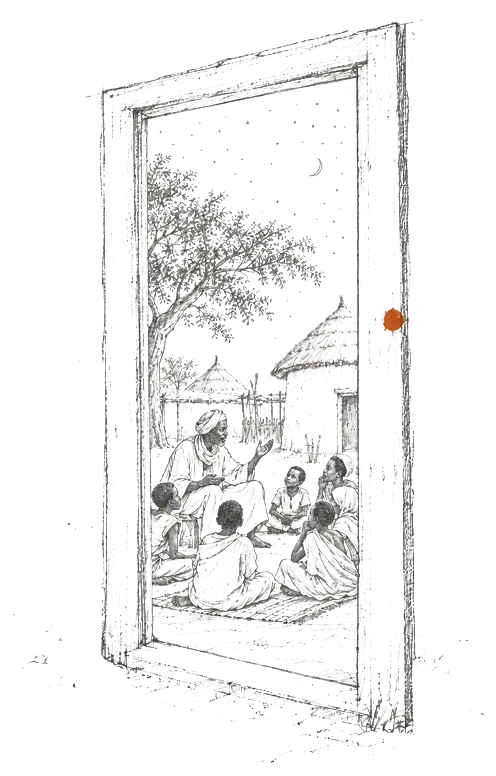
The collection gathers tales and legends of Chad, rendered into French from the oral tradition. A preface presents the country, its seasons and its history, describes the harvest festival with its exchanges and evening dances, and invites the reader to come and sit among the children of Chad. Some tales, from different peoples, sketch the image of a nation of many cultures.
Timeline
- 1962–1967First textsJoseph Brahim Seïd writes down the tales; Sailly makes the first film.
- 1983–1989Theatre and prisonBaba Moustapha, Koulsy Lamko, and Bangui telling Tombalbaye.
- 1994–1995Chadian cinemaZara Mahamat Yacoub, Issa Serge Coelo, Mahamat-Saleh Haroun.
Reading keys
- Names indicate the north or the south: an Arabic or Kanembu name comes from the Muslim north, a Sara name from the Christianised south.
- In the north, genealogy is expressed with ibn and the lineage counts; in the south, classificatory kinship extends the terms brother and uncle.
- Sara in the south and Chadian Arabic in the north serve as lingua francas according to the region, and the choice of language in a dialogue is a piece of political information.
- The yondo initiation, among the Sara, marks entry into adulthood and was politically instrumentalised in the nineteen seventies.
- The civil wars since 1965, the successive regimes and the political prisons, including those of Habré, are recounted in rare testimonies often published in exile.
- The north-south division is not named head-on but organises every narrative.
- Excision, practised in several regions, is a subject whose treatment brought prosecution to a film-maker.
- The question of the receding lake and of conflicts over access to water is a contemporary subject that films address.
- Islam dominates the north and the centre, with Sufi brotherhoods, Christianity and the ancestral cults the south.
- The traditions of Kanem-Bornu, a thousand-year-old Muslim sultanate of the lake basin, produced chronicles in Arabic.
- The margaï, spirits of places among the Sara, and the rain rites survive beneath Christianity.
- The jinn belong to Quranic cosmology in the narratives of the north.
- Muslim mourning is brief, with burial on the same day and three days of condolences; mourning in the south includes a wake and a deferred lifting of mourning.
- Facial scarifications, still visible among the elders, indicate the group of origin.
- Ramadan and the Eids order the year in the north, the Christian feasts in the south, which gives two calendars in one country.
- The bride price, paid in livestock, is negotiated and its amount makes the story.
- The chronicles of Kanem-Bornu, including the Girgam which traces the dynasty back to a Yemeni hero, belong to the memory of the north.
- The Sara tales of the south, with their cunning animals, form the southern narrative stock.
- The narratives of caravans and slave raids run through the memory of both halves of the country.
- Toumaï, a seven-million-year-old hominid skull found in the Djurab desert, has become a national emblem.
- Chad is not an exclusively Saharan country: the south is a zone of humid savanna and rivers, and most of the population lives there.
- The north-south division is not only religious: it is also economic, linguistic and administrative.
- The absence of cinemas did not prevent the existence of a recognised auteur cinema, which reverses the usual relation between audience and creation.
- Lake Chad is not a setting but a vital stake whose shrinking has consequences described in recent works.
Tales and mythologies 2
- TaleTold by Starlight in ChadAu Tchad sous les étoilesJoseph Brahim Seïd · 1962Two years after independence, a jurist from Fort-Lamy publishes in Paris the first book by a Chadian writer.Literature
- ChronicleDiwan of the Sultans of Bornuديوان سلاطين برنوAnonymous · 1808For six centuries, the royal scribes of Kanem added a paragraph at the death of each sultan.Literature
A selection to begin with 9 / 11
- CinemaPêcheurs du ChariÉdouard Sailly · 1966One of the first Chadian films: an ethnographic documentary shot on the banks of the Chari.Cinema
- NarrativePrisonnier de TombalbayeAntoine Bangui · 1980not translated into EnglishA former Chadian minister recounts the three years he spent in the prisons of the regime he had served.Literature
- TheatreLe Crime de la dotDjimet Kari · 1983not translated into EnglishA Chadian drama in four acts, published in N'Djamena, whose title makes the dowry a crime.Literature
- TheatreLe Commandant ChakaBaba Moustapha · 1983not translated into EnglishA Chadian playwright who died at thirty leaves a play against military dictatorships, published after his death.Literature
- PoetryPierre, poussièreNimrod · 1989not translated into EnglishThe first collection of a Chadian poet and philosopher, crowned in the year it appeared.Literature
- TheatreLe Camp tend la sébileKoulsy Lamko · 1993not translated into EnglishA Chadian playwright in exile gives a voice to the refugees whom war has thrown out of the capital.Literature
- CinemaA Taxi for AouzouUn taxi pour AouzouIssa Serge Coelo · 1994A taxi driver from N'Djamena tells his life story, in the year Chad recovers its territory of Aouzou.Cinema
- CinemaDilemme au fémininZara Mahamat Yacoub · 1994A journalist from N'Djamena films an excision and brings a fatwa upon herself.Cinema
- CinemaSotigui Kouyaté: A Modern GriotSotigui Kouyaté, un griot moderneMahamat-Saleh Haroun · 1996A Chadian filmmaker based in France films a griot actor born in Bamako, a companion of Peter Brook.Cinema