Turkmenistan
- works
- 23
- 14 books · 9 films
- period covered
- 1400–1994
- language of writing
- Turkmen
At the beginning of the two thousands, one had to know a certain book in order to obtain a driving licence. Written by the head of state and presented as a spiritual guide of the nation, it was taught in schools, displayed in the public squares, quoted in speeches, and knowledge of it featured in administrative examinations. A country thus made a single text the condition of access to ordinary life. It is the exact opposite of what a literature presupposes, and it happened in a country that otherwise sincerely venerates a poet of the eighteenth century.
Read moreShow less
That poet is called Magtymguly Pyragy, and he is the unanimous reference. He wrote in Turkmen at a time when the scholars of the region composed in Persian or in Chagatai, in a country without a state, divided into tribes, and his poems call for union while describing the life of the herders, the raids and the grief. His father, himself a poet, had written a book of morals that the Quranic schools used. The Turkmens recite them, and the bagşy, bards who play the dutar, sing passages of them at weddings and at evening gatherings.
The written literature of the twentieth century was Soviet and then national, with the same constraints in both cases. Berdi Kerbabayev published in 1928 a narrative about a young girl sold in marriage, a subject authorised because it served the policy of the moment. Cinema produced in the nineteen sixties and seventies a few remarkable films, including one from 1972 about a war widow who refuses to remarry, before shrinking almost to nothing after 1991. The country is today one of the most closed in the world, and its contemporary production circulates little, including within its own borders.
What awaits the reader is a poetry of the steppe and of the desert, highly codified, in which the call to unity returns like a refrain. The divan that opens this page dates from the eighteenth century, and its manuscripts, copied by villagers, scholars and bards, are on UNESCO's Memory of the World register.
A way to begin
Songs from the Steppes of Central Asia
Magtymguly Pyragy · 1770
The poems of an eighteenth-century Sufi scholar who reproaches the Turkmen tribes for their division, free of rights.
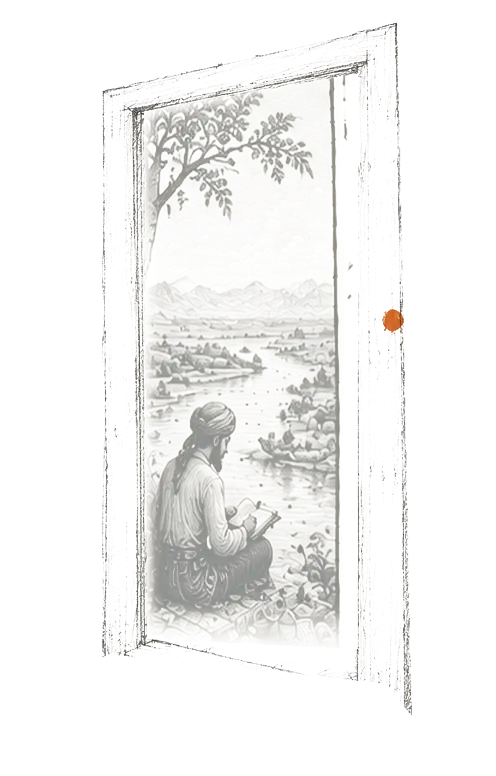
Short poems, in four-line stanzas close to folk song, in which the poet slips his name into the last stanza. They tell of his love for Mengli, given in marriage to another, the loss of two brothers sent on an embassy, the discord of the Turkmen tribes whom he urges to unite, the injustice of the powerful and the vices of the clergy, and the quest of the Sufi struck with awe before God.
Timeline
- 1750–1800Classical poetsAzady, then Magtymguly, who makes Turkmen a literary language.
- 1840–1850Kemine and MollanepesTribal poetry, satirical and amorous, passed on by word of mouth.
- 1926–1941Soviet periodKerbabaev, the first Ashgabat films, and Platonov's Dzhan.
- 1964–1996Turkmen cinemaMansurov, Narliev. Rare films, often shot in the desert.
Reading keys
- Names often end in -ov or -ova, a Russian inheritance, and many have taken up forms in -ogly or -gyzy.
- Tribal belonging, Teke, Yomut, Ersary, Salyr, remains a determining social and political datum, and the name signals it.
- Patrilineal kinship and tribal exogamy organise marriages, and one knows one's genealogy.
- Respect for elders imposes forms of address and an order of precedence.
- Criticism of the authorities is impossible, and the country is among the most closed in the world as regards the press and the circulation of books.
- The massacre of Geok Tepe in 1881, where the Russian army crushed the Turkmen resistance, is officially commemorated.
- The purges of the nineteen thirties wiped out the first generation of Soviet Turkmen writers.
- Restraint is a value, and one shows neither hunger nor grief in public.
- Hanafi Sunni Islam is in the majority, having arrived long ago but long mixed with earlier practices.
- The tombs of saints and of tribal figures are places of pilgrimage where rags are tied to trees.
- Tengrism and the cult of the ancestors survive in domestic rites and in formulas.
- Margiana, around Merv, was a Zoroastrian and then a Buddhist and Manichaean centre, which scholarly memory claims.
- Mourning includes a wake, a swift burial and commemorations on the seventh and the fortieth day.
- The Turkmen carpet, with patterns proper to each tribe, is read like a signature and appears on the national flag.
- Nowruz on 21 March is celebrated, and the Akhal-Teke horse is a national emblem with an almost ritual value.
- The two-stringed dutar accompanies the singing of the bagşy, and a bagşy scene is a scene of collective memory.
- The dessan of Gorogly, the Turkmen version of the Koroglu cycle, is listed as intangible heritage and recited by the bagşy.
- The Book of Dede Korkut is claimed by Turkmenistan, a recently discovered manuscript bearing the title of second volume of the book of the Turkmens.
- Magtymguly's poems are learnt at school and quoted like proverbs.
- The samples of Turkic literature collected by Radloff in the nineteenth century constitute the old documented corpus.
- Turkmen is an Oghuz Turkic language, close to Turkish and to Azerbaijani, and not an Iranian language.
- The carpet is not a decorative object: its patterns identify a tribe and its ownership is transmitted.
- The country's isolation since 1991 makes its recent production almost inaccessible, which explains a catalogue that stops early.
- Magtymguly is claimed by Iran, where he was born and is buried, and by Turkmenistan: the borders came after him.
Tales and mythologies 2
- EpicGörogly dessanyAnonymous · 1700not translated into EnglishA heroic cycle that Turkmen bards sing in episodes, between spoken passages.Literature
- EpicThe Book of Dede KorkutKitaby Dädem GorkutAnonymous · 1400The tales of the Oghuz, ancestors of the Turkmens, long recited by bards before being set down in writing.Literature
Available in English 3
The books from this country that can be read in English, in the original or in translation.
- PoetrySongs from the Steppes of Central AsiaDiwanMagtymguly Pyragy · 1770The poems of an eighteenth-century Sufi scholar who reproaches the Turkmen tribes for their division.Literature
- NovelSoulDzhanAndrei Platonov · 1935An envoy from Moscow charged with saving a people who have nothing left but their soul, in the sands of the Karakum.Literature
- NovelThe Tale of AypiAýpi hakyndaky rowaýatAk Welsapar · 1988Caspian fishermen threatened with eviction and the ghost of a woman: the novel of a Turkmen writer in exile.Literature
A selection to begin with 10 / 23
- PoetryWagzy-AzatDovletmammet Azadi · 1754not translated into EnglishA treatise in verse on good government, written in the eighteenth century for Turkmen tribes that had no state.Literature
- NovelSoulDzhanAndrei Platonov · 1935An envoy from Moscow charged with saving a people who have nothing left but their soul, in the sands of the Karakum.Literature
- NovelAýgytly ädimBerdi Kerbabayev · 1940not translated into EnglishThe revolution seen from a Turkmen village, by the writer who became the official figure of the country's letters.Literature
- CinemaThe ContestSostyazanieBulat Mansurov · 1963A duel between musicians standing in for a battle, taken from a Turkmen tale and filmed as a graduation project.Cinema
- CinemaMakhtumkuliAlty Karliev · 1968The life of the great Turkmen poet brought to the screen, between his native aul and a khan's court.Cinema
- CinemaDaughter-in-LawNevestkaKhodzhakuli Narliev · 1972The wait of a widow who refuses to be one, beside an old shepherd, in the silence of the desert.Cinema
- CinemaTaynyy posolKhalmamed Kakabaev · 1986A clandestine embassy to the tsar's court, at the time when the Turkmen tribes were seeking a protector.Cinema
- NovelThe Tale of AypiAýpi hakyndaky rowaýatAk Welsapar · 1988Caspian fishermen threatened with eviction and the ghost of a woman: the novel of a Turkmen writer in exile.Literature
- CinemaLegenda drevnikh gorYazgeldy Seidov · 1988A bird hunt in the Turkmen heights, where the grandfather and the child learn from each other.Cinema
- CinemaKarakumArend Agthe and Usman Saparov · 1994Two boys who cannot understand each other, alone in the desert with a broken-down truck and plenty of ideas.Cinema