Turkey (Türkiye)
- works
- 95
- 53 books · 42 films
- period covered
- 1300–1999
- language of writing
- Turkish
On 1 November 1928, a country changed its alphabet in a few months. Turkey abandoned Arabic characters for the Latin alphabet, and Mustafa Kemal travelled the country with a blackboard to teach it himself in the public squares. The decision was efficient and brutal: those who could read no longer could, those who learnt could no longer decipher what had been printed before them. Four years later, a commission set about purging the language of its Arabic and Persian vocabulary. A Turk of today does not read a text from 1920 without a translation.
Read moreShow less
It is the most radical rupture a modern literature has undergone, and it was deliberate. Six centuries of Ottoman poetry, written in a court language mixed with Arabic and Persian, tipped over to the side of the inaccessible past, and the authors of the Republic had to fabricate a new literary language with a purified vocabulary. Some saw in it a liberation, others an amputation, and that dispute is not closed.
The dominant form is the novel of the village and of migration to the city, served by a deliberately simple language. Yaşar Kemal recounted from 1955 the peasants of Çukurova and a bandit become an avenger, in a prose fed by the oral narratives he collected as a child. Ahmet Hamdi Tanpınar published in 1961 the comedy of an absurd institution and stated the melancholy of a country that had cut with itself. The price was heavy: Nâzım Hikmet spent twelve years in prison, lost his nationality in 1951 and died in Moscow; Yılmaz Güney wrote a film in detention, had it directed by another, escaped, edited it in Switzerland, won the Palme d'Or in 1982, and the film remained banned at home for seventeen years.
What awaits the reader is a literature of avowed loss, looking back at a civilisation it can no longer read. The novel that opens this page follows a boy from the Taurus who takes to the hills against the agha of his village, and it has been translated into more than twenty languages.
A way to begin
Memed, My Hawk
Yaşar Kemal · 1955
A boy from the Taurus takes to the hills against the agha who rules his village: Yaşar Kemal's novel, translated into more than twenty languages.
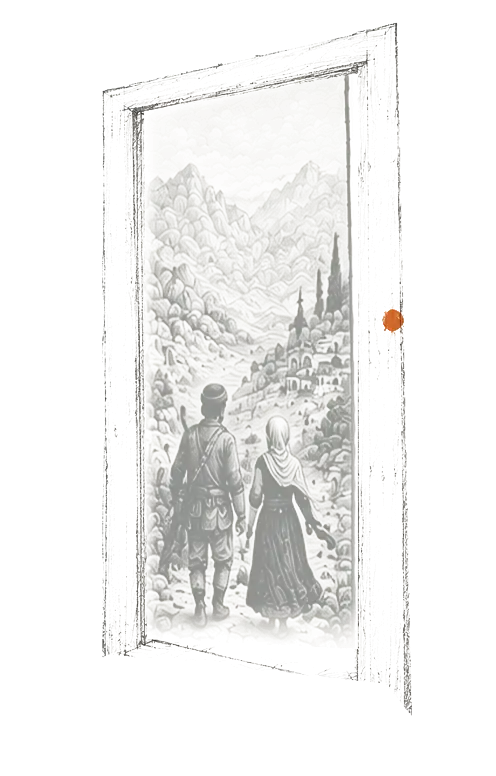
In Deyirmenoluk, a village in the Taurus, the agha Abdi takes the larger share of the peasants' harvests and beats young Memed, who lives with his widowed mother. The boy runs away to old Süleyman; the agha has him brought back and punishes the family to the point of famine. As a young man, Memed loves Hatche, whom the agha has promised to his nephew, and runs off with her; pursued, he takes to the mountains and joins a band of brigands.
Timeline
- 1300–1839Divan poetryA learned court poetry, in Ottoman Turkish fed by Arabic and Persian.
- 1860–1896TanzimatThe reforms. The novel, the newspaper and the theatre arrive from Europe.
- 1923–1950RepublicLatin alphabet, purified language. Nâzım Hikmet writes half his work in prison.
- 1950–1980Village novelYaşar Kemal, Orhan Kemal. Anatolia enters literature.
- 1960–1975YeşilçamA popular film industry, immense and long looked down on.
Reading keys
- Family names have existed only since 1934: everyone had to choose one, often a favourable Turkish word, which explains names like Öz, Demir or Kemal.
- The first name is often enough, and suffixes of respect are added: bey for a man, hanım for a woman, abi for an older brother, abla for an older sister. An older stranger is addressed as "brother" or "sister".
- Kurdish, Arabic or Armenian names are turkified in the older documents, and the original name sometimes reappears in the narratives.
- The kinship bond through milk, between children nursed by the same woman, creates an impediment to marriage and a narrative motif.
- The genocide of the Armenians in 1915 is a subject whose designation is framed by criminal law, and several authors have been prosecuted for addressing it.
- The Kurdish question, the long-maintained prohibition of the language and the conflict since 1984 are high-tension subjects.
- Kemalist secularism and the place of religion have divided the country for a century, and the veil is an explicit political marker.
- An article of the penal code punishes insult to national identity, which has brought trials against writers, including a Nobel laureate.
- Sunni Islam is in the majority, but the state is officially secular and manages worship through a state administration, a situation without regional equivalent.
- The Alevis, between ten and twenty per cent of the population, have their own places, their own rites and their own poets, including Âşık Veysel, and do not attend mosques.
- The Sufi brotherhoods, including the whirling dervishes of Konya, were banned in 1925 and survive in other forms.
- The evil eye and blue amulets are in universal use, including among non-believers.
- Muslim mourning is brief, with burial on the same day, three days of condolences and a reading on the fortieth.
- The red of the flag and of the bride's scarf has no funeral value; black is worn in mourning in the cities.
- Ramadan reverses the rhythm of the days, and Eid al-Kabir commits the economy of a whole family.
- Military service, compulsory and long, gives rise to farewell celebrations that often serve as a narrative hinge.
- The Book of Dede Korkut, a collection of Oghuz narratives, is the claimed founding text, also claimed by Azerbaijan and Turkmenistan.
- Nasreddin Hodja, whose jests are learnt from childhood, also exists in Arabic under the name of Juha, in Berber, in Greek and throughout the Balkans.
- The tales of Istanbul collected in 1905 by a Hungarian Turkologist, with their princes and their dervishes, form the documented corpus.
- The poems of Yunus Emre, from the fourteenth century, and those of the Alevi poets are recited and sung, including by secular people.
- Turkey is not an Arab country: the language is Turkish, of another family, and Ottoman history is distinct from Arab history.
- The reform of 1928 did not simplify a script: it cut off access to six centuries of texts, which the authors experience as a loss.
- The Alevis are not marginal heterodox Muslims but a major component of society, with a literature of their own.
- Kemalism is not a national consensus but a political project contested from the start, and literature gives an account of it.
Tales and mythologies 1
- EpicThe Book of Dede KorkutDede Korkut KitabıAnonymous · 1400Twelve tales of nomad heroes, through which an old bard who gives names passes.Literature
A selection to begin with 10 / 95
- NovelFalling LeavesYaprak DökümüReşat Nuri Güntekin · 1930An honest father watches his household fall apart, as his family seek a life that is not theirs.Literature
- PoetryOddGaripOrhan Veli Kanık · 1945Poems in spoken language, without metre or rhyme, about ordinary life.Literature
- NovelThe Time Regulation InstituteSaatleri Ayarlama EnstitüsüAhmet Hamdi Tanpınar · 1961The memoirs of a former watchmaker's apprentice, drawn by a bureaucrat into the creation of an institute devoted to the correct time.Literature
- PoetryHuman Landscapes from My CountryMemleketimden İnsan ManzaralarıNâzım Hikmet · 1966A novel in verse that starts from two trains leaving Istanbul and crosses an entire society.Literature
- CinemaDevlet KuşuMemduh Ün · 1980A poor boy hesitates between his neighbour and a contractor's daughter.Cinema
- CinemaKırık Bir Aşk HikâyesiÖmer Kavur · 1981A newly arrived teacher and a reluctant fiancé, in Ayvalık.Cinema
- CinemaYolYılmaz Güney and Şerif Gören · 1982Five prisoners on leave return to a country under military rule.Cinema
- CinemaÇiçek AbbasSinan Çetin · 1982A minibus apprentice dreams of his own vehicle and of his boss's fiancée.Cinema
- CinemaBir Yudum SevgiAtıf Yılmaz · 1984A mother of four children goes to work in a factory and takes charge of her life.Cinema
- NovelThe White CastleBeyaz KaleOrhan Pamuk · 1985A captive Venetian scholar and his Ottoman master, who resembles him feature for feature.Literature