Uruguay
- works
- 38
- 24 books · 14 films
- period covered
- 1842–2000
- language of writing
- Spanish
Uruguay is a country without an indigenous mythology, and that is not an oversight. On 11 April 1831, on the orders of the Republic's first president, the army gathered the Charrúa under the pretext of negotiating and massacred them beside a stream called Salsipuedes. The survivors were dispersed, four of them sent to Paris as scientific curiosities. No ethnographic inquiry was ever conducted among them: their language, their narratives and their beliefs disappeared before anyone thought of writing them down. The documentary gap here is the direct result of an extermination.
Read moreShow less
The country filled that void with literature. Zorrilla de San Martín published in 1888 a long poem about the last Charrúa, an entirely invented character, melancholy and doomed to disappear, which served for a century as a national myth. A novelist took up the question differently in 1988, by having a narrator investigate the massacre through the written and oral versions, including that of a sergeant who had witnessed it. Between the two, a century passed, and the country ceased to find the poem comfortable.
That absence of an old stock produced an exceptionally urban, cerebral literature without epic. Horacio Quiroga wrote short stories in which nature kills without intention, Felisberto Hernández invented in 1943 a prose of reverie that nobody has imitated, Juan Carlos Onetti founded in 1950 an imaginary city inhabited by men who give up, and Mario Benedetti gave in 1960 the journal of an office clerk who discovers happiness three months before dying. Eduardo Galeano rewrote in 1971 the history of the continent from the side of the victims, in a book that would be banned by three dictatorships.
What awaits the reader is a literature of clerks, boarding houses and small towns, in which nothing great happens and that is the subject. The collection that opens this page gathers stories first published in Buenos Aires magazines, and it established its author as a master of the short story.
A way to begin
Tales of Love, Madness and Death
Horacio Quiroga · 1917
The collection that made Horacio Quiroga the master of the short story, free of rights.
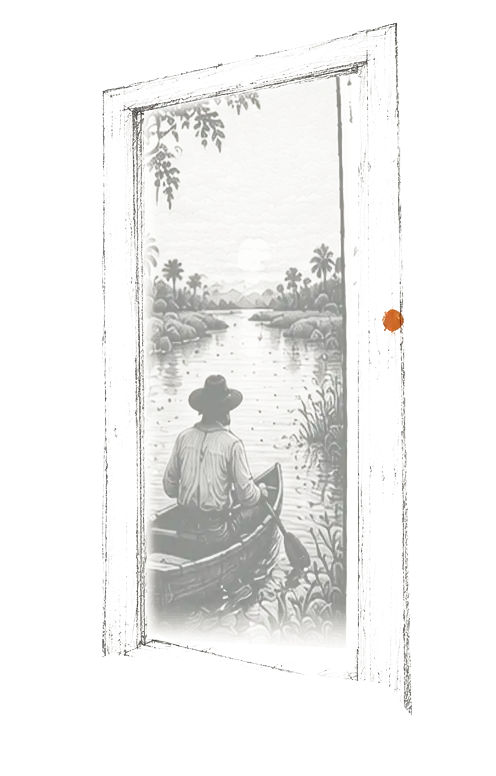
Eighteen stories in which love, illness and madness lead towards death. A man bitten by a snake goes down the river in a canoe to seek help; a young bride weakens from an ailment no doctor can explain; four sick brothers, facing a wall, watch the maid bleed a hen.
Timeline
- 1886–1905FoundationZorrilla de San Martín, Acevedo Díaz. The country gives itself a past.
- 1904–1925ModernismoQuiroga, Agustini, Herrera y Reissig, Ibarbourou.
- 1936–1950First films and OnettiCinema begins; A Brief Life invents Santa María.
- 1960–1971The 1945 generationBenedetti, Martínez Moreno, Galeano. Writing before the dictatorship.
- 1982–1999Return to democracyPeri Rossi in exile, de Mattos at home, and a cinema starting up again.
Reading keys
- The Spanish usage of two surnames applies, and the second is commonly used.
- Italian and Spanish names dominate: the country received a massive immigration and its population is almost entirely of European origin, a rare case in South America.
- Vos replaces tú as throughout the Río de la Plata region.
- Names of African origin have disappeared, but a minority Afro-Uruguayan population exists, long invisible in the literature.
- The Salsipuedes massacre of 1831 has been acknowledged only recently and was long presented as a pacification.
- The dictatorship from 1973 to 1985, which made the country the one with the most political prisoners per inhabitant in the world, is a subject on which every account is situated.
- The amnesty law of 1986, confirmed by two referendums, blocked prosecutions and remains a dispute.
- The idea of an exceptionally European and egalitarian country is a national narrative that literature questions.
- Uruguay is the most secularised country in Latin America: the state separated from the Church as early as 1919, the religious festivals were renamed, Christmas is officially called family day and Holy Week tourism week.
- Catholicism is a minority in practice, and an important part of the population declares itself without religion.
- The Afro-Brazilian religions, umbanda in particular, are practised in the working-class quarters of Montevideo.
- Candombe, an Afro-Uruguayan drum listed as intangible heritage, descends from the African nations of the colonial period and is played in procession in the street.
- The wake and the swift burial organise the mourning, with few religious rites.
- Mate is shared as in Argentina, with the same protocol and the same social value.
- The carnival, the longest in the world with forty days, includes murgas, satirical choruses that comment on the political year, and candombe parades.
- 18 July and 25 August, the dates of the Constitution and of independence, structure the civil calendar.
- The 1886 poem about the last Charrúa fixed the national image for a century, and its questioning is today a critical commonplace.
- The beliefs of the Río de la Plata, with the Lobizón, the Luz Mala and the Salamanca, collected in 1896, form the documented corpus.
- Candombe, its drums and its characters, including the Mama Vieja and the Gramillero, are a shared reference.
- The tales of Pedro Urdemales circulate as throughout Hispanic America.
- Uruguay is not a little Argentina: its secularism, its political system and its literature have features of their own.
- The absence of an indigenous mythology is the result of a massacre and not of an absence of peoples.
- Candombe is not a variant of the Brazilian carnival: it comes from the African nations of Montevideo and has a history of its own.
- The apparent calm of the country and the sobriety of its literature are not indifference: the dictatorship there was one of the most systematic on the continent.
Tales and mythologies 1
- EssayReseña histórico-descriptiva de antiguas y modernas supersticiones del Río de la PlataDaniel Granada · 1896not translated into EnglishThe two banks of the great estuary at the end of the nineteenth century, where a jurist based in Salto records the beliefs of the countryside.Literature
Available in English 9
The books from this country that can be read in English, in the original or in translation.
- TheatreDown the GullyBarranca abajoFlorencio Sánchez · 1905The Uruguayan countryside at the beginning of the century, where an old landowner stripped of his property by the men of the law also loses his family.Literature
- Short storiesTales of Love, Madness and DeathCuentos de amor de locura y de muerteHoracio Quiroga · 1917Stories of forest, river and brothel, in which passion and illness lead to death.Literature
- NovelCastanetsEl embrujo de SevillaCarlos Reyles · 1922A Seville of festival and fervour, seen through its dancers, its singers and its bullfighters.Literature
- NarrativeThe Daisy DollsLas HortensiasFelisberto Hernández · 1949A bourgeois house where display cases of dolls blur the boundary between things and people.Literature
- NovelA Brief LifeLa vida breveJuan Carlos Onetti · 1950Buenos Aires around 1950, where a man whose life is threatened splits himself in two by inventing a city.Literature
- NovelThe Truce: The Diary of Martín SantoméLa treguaMario Benedetti · 1960Montevideo, in the ordered life of an office clerk nearing retirement.Literature
- EssayOpen Veins of Latin AmericaLas venas abiertas de América LatinaEduardo Galeano · 1971Latin America from the conquest to the seventies, read as the history of a plunder.Literature
- NovelThe Ship of FoolsLa nave de los locosCristina Peri Rossi · 1984Europe at the end of the twentieth century, seen by an exile who settles nowhere.Literature
- NovelThe Letters That Never CameLas cartas que no llegaronMauricio Rosencof · 2000A neighbourhood of Montevideo during the Second World War, then the cell of a political prisoner.Literature
A selection to begin with 10 / 38
- PoetryTabaréJuan Zorrilla de San Martín · 1888not translated into EnglishThe son of a Charrúa cacique and a Spanish captive, caught between two peoples in the time of the conquest.Literature
- Feature filmAsí te deseoBelisario García Villar · 1948The Uruguayan studios of the late forties, where films are shot for Argentine screens.Cinema
- NovelA Brief LifeLa vida breveJuan Carlos Onetti · 1950Buenos Aires around 1950, where a man whose life is threatened splits himself in two by inventing a city.Literature
- Feature filmPrisoner 1040Procesado 1040Rubén W. Cavallotti · 1958An Argentine prison of the fifties, where an old man guilty of no great crime becomes a number.Cinema
- Short filmComo el Uruguay no hayUgo Ulive · 1960Uruguay in 1960, a “little democratic paradise” that the film mocks.Cinema
- NovelThe Truce: The Diary of Martín SantoméLa treguaMario Benedetti · 1960Montevideo, in the ordered life of an office clerk nearing retirement.Literature
- EssayOpen Veins of Latin AmericaLas venas abiertas de América LatinaEduardo Galeano · 1971Latin America from the conquest to the seventies, read as the history of a plunder.Literature
- Feature filmMataron a Venancio FloresJuan Carlos Rodríguez Castro · 1982Uruguay in 1868, when the country's two parties tear each other apart to the point of murder.Cinema
- Novel¡Bernabé, Bernabé!Tomás de Mattos · 1988not translated into EnglishUruguay in 1831, when the army exterminates the Charrúas, reread a hundred and fifty years later.Literature
- Feature filmMestizoMario Handler · 1988Venezuela in the eighties, where an exiled Uruguayan documentary maker shoots a fiction film about a fishing village.Cinema