Vietnam
- works
- 53
- 33 books · 20 films
- period covered
- 1337–2000
- language of writing
- Vietnamese
The Vietnamese open a poem at random to find out what is going to happen to them. The Kim Vân Kiều, three thousand two hundred and fifty-four lines written around 1820 by a mandarin scholar, recounts a young woman who sells herself to save her father and goes through fifteen years of misfortunes. It is learnt at school, its lines are quoted in ordinary conversation, and it is used as a domestic oracle. A country has made a single poem its book of wisdom, its national novel and its manual of divination, and its morality is still debated.
Read moreShow less
The text was written in nôm, a system that adapts Chinese characters to note Vietnamese, a language that has no kinship with Chinese. That learned writing, which required knowing Chinese first, was replaced under colonisation by a Latin alphabet devised by Jesuit missionaries in the seventeenth century. The result is double: Vietnam is the only country in East Asia to write in Latin letters, with its stacked accents, and it has lost direct access to a thousand years of its own production.
The dominant form of the twentieth century is the poem and then the war narrative. The nineteen thirties produced a lyrical generation that introduced free verse, before literature became an instrument of mobilisation during thirty years of war. The reopening of the nineteen eighties was spectacular: Nguyễn Huy Thiệp published in 1987 the short story of a general who has come home and become useless, a dry text that caused a scandal and was brought to the screen the following year, and Dương Thu Hương, a former combatant, wrote against the regime and found herself imprisoned.
What awaits the reader is a literature in which filial piety is the main device and in which a woman's sacrifice saves a family, without anybody thanking her for it. The poem that opens this page follows fifteen years of trials of a girl who sold herself to save her father, and it asks whether heaven must so hound talent and beauty.
A way to begin
The Tale of Kieu
Nguyễn Du · 1820
Vietnam's national text, learned by heart generation after generation: a girl whom filial duty casts out of her life. Free of rights.
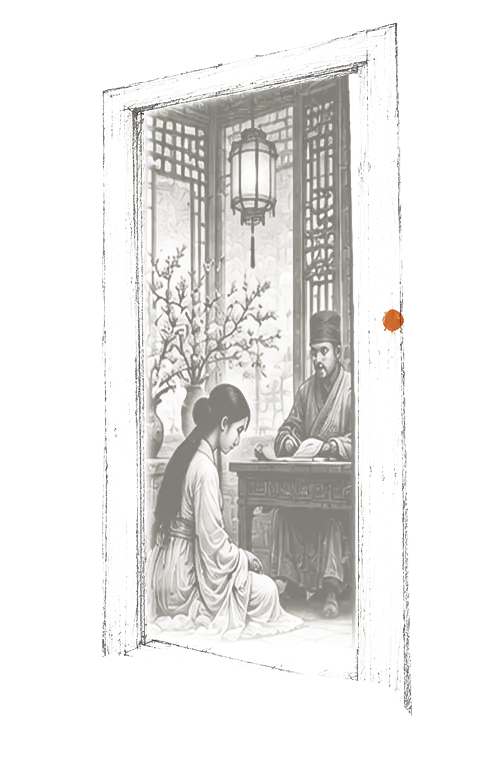
Thúy Kiều, beautiful and gifted, pledges her faith to a young man of her station, then sells herself in marriage to save her father from an accusation that ruins the family. What she took for a marriage leads her to a brothel; fifteen years of trials follow, servitude, flight, a convent, a second forced marriage, in which she passes from hand to hand without ever losing what she is. The poem asks whether heaven must so hound talent and beauty.
Timeline
- 1010–1800Sino-Vietnamese lettersWriting is in classical Chinese, then in a Vietnamese script derived from it.
- 1820The Tale of KiềuNguyễn Du writes the poem the whole country will know by heart.
- 1930–1945ModernityQuốc ngữ, the Latin alphabet, takes hold. A modern prose appears.
- 1945–1975WarsThirty years of war, against France then the United States. Literature is mobilised.
Reading keys
- The family name precedes the first name, and people are called by their first name: Nguyễn Du is Mr Du. The name Nguyễn concerns nearly four Vietnamese in ten.
- Kinship terms encode age, the side of the family and birth rank, and one addresses everybody by a kinship term: a stranger is uncle, aunt, elder brother or little one according to age.
- The first-person pronouns change according to the interlocutor: saying "I" means choosing one's place in a hierarchy.
- Filial piety is a legal duty as much as a moral one, and the cult of the ancestors passes to the eldest son.
- The single party practises prior censorship and several authors have been imprisoned or banned since 1990.
- The war is officially recounted as a victory, and narratives that show the distress of the combatants have caused scandals.
- The fate of the South Vietnamese after 1975, the re-education camps and the exile by sea are subjects that are written about only abroad.
- Restraint is a value, and one does not contradict an elder in public.
- Mahayana Buddhism, Confucianism and Taoism combine in a single practice, which distinguishes Vietnam from the rest of Theravada South-East Asia.
- The cult of the ancestors is the central practice: every house has its altar, and the dead are fed on the anniversary dates.
- The wandering souls, the dead without burial or descent, come back and are the object of a whole month of rites in summer.
- Caodaism, a syncretic religion born in 1926 that also venerates Victor Hugo, has millions of faithful and is not a curiosity.
- White is the colour of mourning, worn as a headband, and funerals include a wake, a burial and then an exhumation after a few years in certain regions.
- The anniversary of the death, and not that of the birth, is the date one celebrates for a deceased person.
- Tết, the lunar new year, brings the country to a halt and imposes the return to the village and the settling of debts.
- The áo dài, a slit tunic worn over trousers, indicates the occasion and the status.
- The Kim Vân Kiều is the text that everyone knows, and its lines serve as proverbs and as an oracle.
- The poems of Hồ Xuân Hương, a woman of the early nineteenth century who wrote texts with an erotic double meaning, are recited with delight.
- The myth of the dragon and the fairy, ancestors of the Vietnamese people, and that of Lạc Long Quân found the national origin.
- The Collection of the Marvels of Linh Nam, from the fourteenth century, gathers the narratives of foundation and the protecting spirits.
- Vietnamese has no kinship with Chinese, despite a thousand years of writing in adapted Chinese characters.
- The family name precedes the first name, and people are called by their first name, which Western bibliographies reverse.
- Vietnam belongs to the sinicised world and not to the Indianised one, unlike its Mekong neighbours: Mahayana Buddhism, Confucianism, cult of the ancestors.
- The American war is one episode among a thousand years of conflicts with China, and Vietnamese literature speaks of it far less than one imagines.
Tales and mythologies 1
- TaleWondrous Tales of Linh NamLĩnh Nam chích quáiAnonymous · 1380A fourteenth-century collection that puts into writing the legends of the country's origins, handed down until then by word of mouth.Literature
A selection to begin with 10 / 53
- PoetryLưu hương kýHồ Xuân Hương · 1814not translated into EnglishA manuscript collection handed over in 1814 to a friend asked to write its preface, and rediscovered a century and a half later.Literature
- NovelDumb LuckSố đỏVũ Trọng Phụng · 1936A satire of colonial Hanoi in the thirties and its Westernised bourgeoisie, in which a good-for-nothing rises the higher the emptier he is.Literature
- NovelWhen the Light Is OutTắt đènNgô Tất Tố · 1937A novel of the Red River delta, serialised in 1937, in which a peasant woman is driven into a corner by the colonial tax.Literature
- CinemaWhen the Tenth Month ComesBao giờ cho đến tháng MườiĐặng Nhật Minh · 1984A 1984 film about a young widow who hides her bereavement from a dying old man and forges letters from the war to do so.Cinema
- Short storiesThe General RetiresTướng về hưuNguyễn Huy Thiệp · 1987A narrative of 1987 about a retired officer returned to a family where money settles everything, which caused a scandal by its refusal to judge.Literature
- CinemaGánh xiếc rongViệt Linh · 1988A film of 1988 about a small troupe of travelling performers who stop in a famished highland village and discover that these destitute people keep gold.Cinema
- CinemaTướng về hưuNguyễn Khắc Lợi · 1988A 1988 film based on a story published the previous year, about an officer returned to a family where money has replaced respect.Cinema
- NovelThe Sorrow of WarNỗi buồn chiến tranhBảo Ninh · 1990Published in 1990 under a title imposed by its publisher, this novel recounts the war through the memory of a survivor who can no longer write its history.Literature
- CinemaHãy tha thứ cho emLưu Trọng Ninh · 1993A 1993 film, released after a year's wait before the censors, in which the Hanoi youth of the renewal period face the generation that fought the war.Cinema
- CinemaThe Wild ReedCỏ lauVương Đức · 1993A 1993 film in which a soldier whom his family believed dead returns after twenty years to a province that is still burying its missing.Cinema